I surrender
If AI already codes better than I do and reviewing all of its code is impractical, what is my role?
- Published
- Reading
- 5 minutes
- Language
- English (translated from Portuguese)
- Topics
- Artificial Intelligence
Translated from Portuguese. First published on Code Capital.
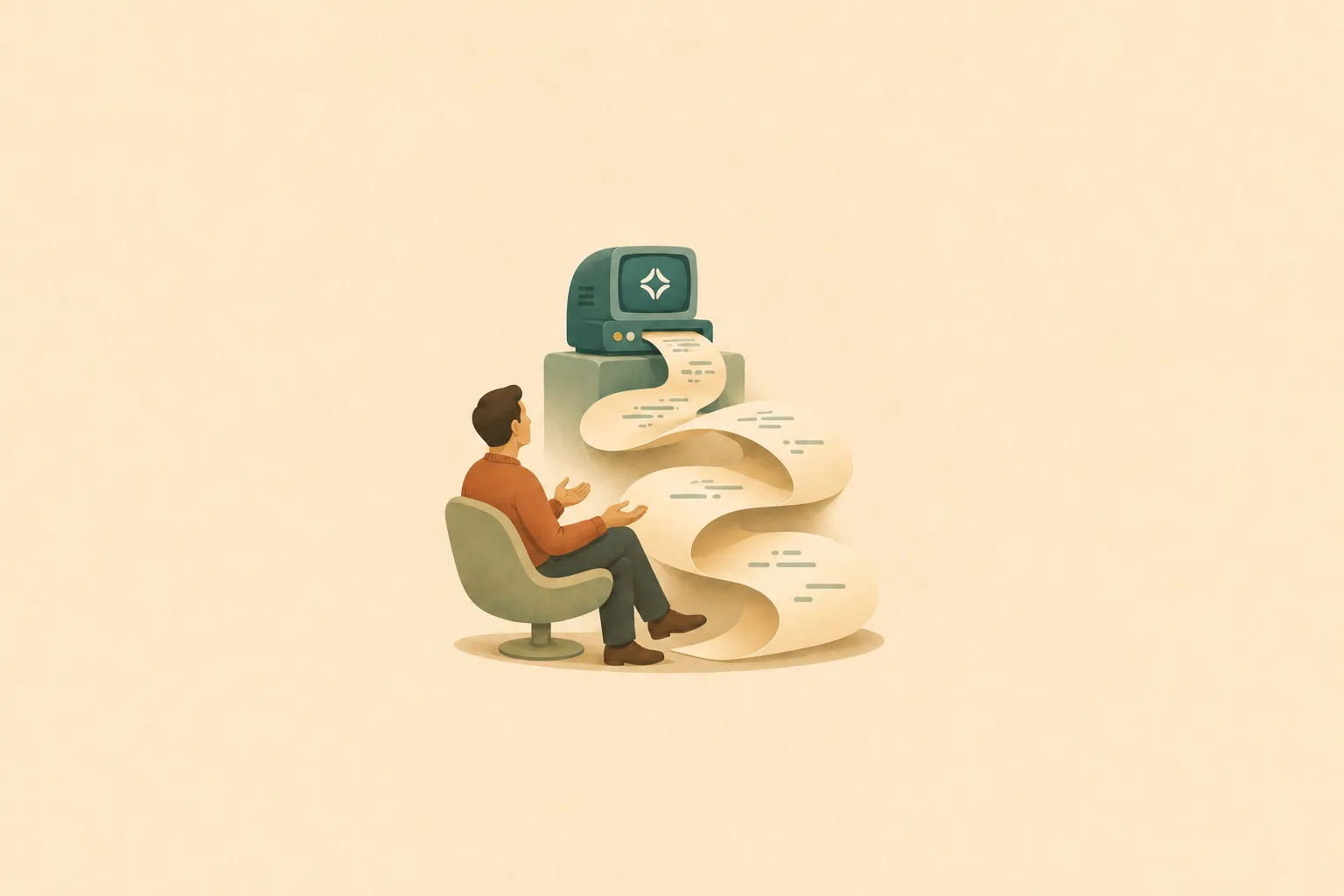
Technological progress is frequent and, more often than not, incremental. Even so, every now and then certain events take place that, in retrospect, mark the beginning of a new era.
So it was about a year ago, when a succession of releases from OpenAI, Anthropic and Google (in Portuguese) won over, once and for all, those who until then had looked at generative AI with suspicion. Then, in August of this year, came a new inflection point: with the release of GPT-6 Astra, it became clear that AI had turned computer use (that is, the ability of AI to operate a piece of software through its interface, without relying on APIs) into a solved problem, and that it had also become good enough at 3D modeling.
But perhaps the news that struck me most was the release of Opus 5.5 on September 22, 2026, which may well be the most impressive release to date. I don't say this in terms of raw intelligence, certain as I am that it is only a matter of time before it is surpassed — if it hasn't been already — but because of its rare combination of price, speed and capability. In other words: a model that not only does its job, but does it in the best possible way, quickly, and without spending much.
For me, Opus 5.5 effectively marked the victory of AI over humans in programming. That was when I chose to throw in the towel: AI writes code better and faster than I do most of the time, and there is no point in resisting.
Until then, even though I had always been in the vanguard and openly pro-AI, I still insisted on controlling the generated code, reviewing it more or less meticulously, and I allowed myself to get irritated at some of the decisions it made. Since that release, all of that has become cope — a last, unconscious attempt to resist a defeat that had been decreed long before.
Some will argue that AI is not perfect, that the code still has bugs, and that here and there bad decisions are made and human intervention is needed. I don't disagree, but when did that stop being true of us? Or was all code immune to bugs before AI, and every architectural decision the right one? Be that as it may, my aim in this text is not to justify myself. If you disagree with me, that's fine — it's a matter of time.
And then AI's newest feat was proclaimed: the proof of the Riemann Hypothesis, a mathematical problem that had stood since 1859. In a way, I felt relieved: if even the hardest mathematical problems in history are being solved, and the most brilliant mathematicians openly confess that they do not understand the whole logical chain, who am I trying to fool with my humble CRUDs, webhooks, services and APIs? Must I really pretend that the same AI capable of the most complex reasoning would not be good enough for my SaaS?
But my heart was warmed even more when I read, in a text shared on X, an annotated excerpt from lesson 185 of Prof. Olavo de Carvalho's Curso Online de Filosofia.1The lesson and the text it is based on are in Portuguese; the passages quoted here are translated from them. There, Olavo discussed the intrinsic limitation of the science of logic, with his well-known foresight about what would come to pass with computer programs themselves.
“Suppose you have followed a long demonstration on the blackboard. The lecturer wrote one proposition, then another, then another, and so on until the conclusion. It is a series of facts that unfold in time. However, if afterwards you are unable to apprehend the entire demonstration simultaneously, as a set of relations independent of time, the validity of the demonstration will escape you entirely.”
That is [says Olavo], when you reach the conclusion, the links between the previous propositions that guarantee the validity of the proposition have already vanished from your circle of consciousness, so the final proposition, the conclusion, seems to you a proposition like any other, guaranteed by nothing but itself.
“It so happens that, with the development of logical technique and the use of computers, it is possible to trace logical chains so long that they escape any possibility of human verification: no human being is able to follow every step of the demonstration and retain them in memory so as to apprehend, in the end, the unity between them and the conclusion.”
This possibility that exists today in computers is a function of the possibility of logic, which in turn is a function of the continuity of human consciousness. Human consciousness makes the science of logic possible, and logic, as it perfects itself, can create binary codes, computers and so on, and from there create deductive chains so immensely long that no human being could hold them in memory until reaching the end and checking whether it is right. That is, the continuity of human consciousness creates technical possibilities that transcend the possibility of verification by that same human consciousness.
The lesson as a whole is absolutely brilliant, and I recommend reading it in full. But what peace it is to read this passage! How comforting to understand that we are not alone, and that everything that is happening is absolutely logical and, in a way, inevitable!
Just as the development of the science of logic could bring about nothing but its own inability to solve the problems it originally set out to solve, so programming would inevitably evolve to a point where understanding the code would become impossible, even though the final object created would remain a functional datum of reality.
It is hard not to recognize exactly this in what we are living through today. The discipline of programming logic, when taken to the extreme, is capable of developing relations so complex and intricate that understanding each step of the logical chain becomes impractical — which in no way invalidates the relevance of the solution, or of whatever has been created.
The impact of this realization is decisive, for better or for worse. If this is reality — and I repeat, even if you disagree with me on this or that particular case, it is merely a matter of time — then it is essential that we learn to deal with it. Despairing is foolish; there is much to be done, and it is liberating to make peace with our conscience. It is up to each of us to look in the mirror and ask: “if AI already codes better than I do and reviewing all of its code is impractical, what is my role?”
Incidentally, I hate to turn this text into a sales pitch, but answering that question is the mission I set for Programe.ai. Its AI Engineer track, with the courses Fundamentals of AI Engineering, Agentic Programming and Harness Engineering (all in Portuguese), is my proposal for a holistic, agnostic education for those who want to get the most out of AI agents. That is also why I decided that every course comes with lifetime access, so that it is possible to watch, rewatch and solidify this knowledge that has become so vital.
Returning to the question of our role in this new era, I intend to explore this existential question for all of us programmers in the coming articles. I can already say that the future excites me, and that the sooner we understand that we need to go beyond mere technical mastery of the craft, the better.
I will close with a passage from the text Crença e Sistema (“Belief and System”), used in that lesson, which gives us a hint of where to look:
“Put another way: the more the instruments of logic are perfected, the more the operations it performs tend to escape all human control and to depend on an act of faith in the authority of the scientific community.”
To which Olavo adds:
Not only in the scientific community, but also in the reliability of computer manufacturers, and so on. What you can say is this: it is unlikely that the computers are wrong, or that the error lies with the entire scientific community. In fact, it is highly unlikely. Only now the notions of the necessary and the impossible have come to depend on a probability, which is not a logical element at all.
Sounds familiar? In the coming articles we will explore the question of trust in authority when we are no longer able to encompass the logical process in its entirety.